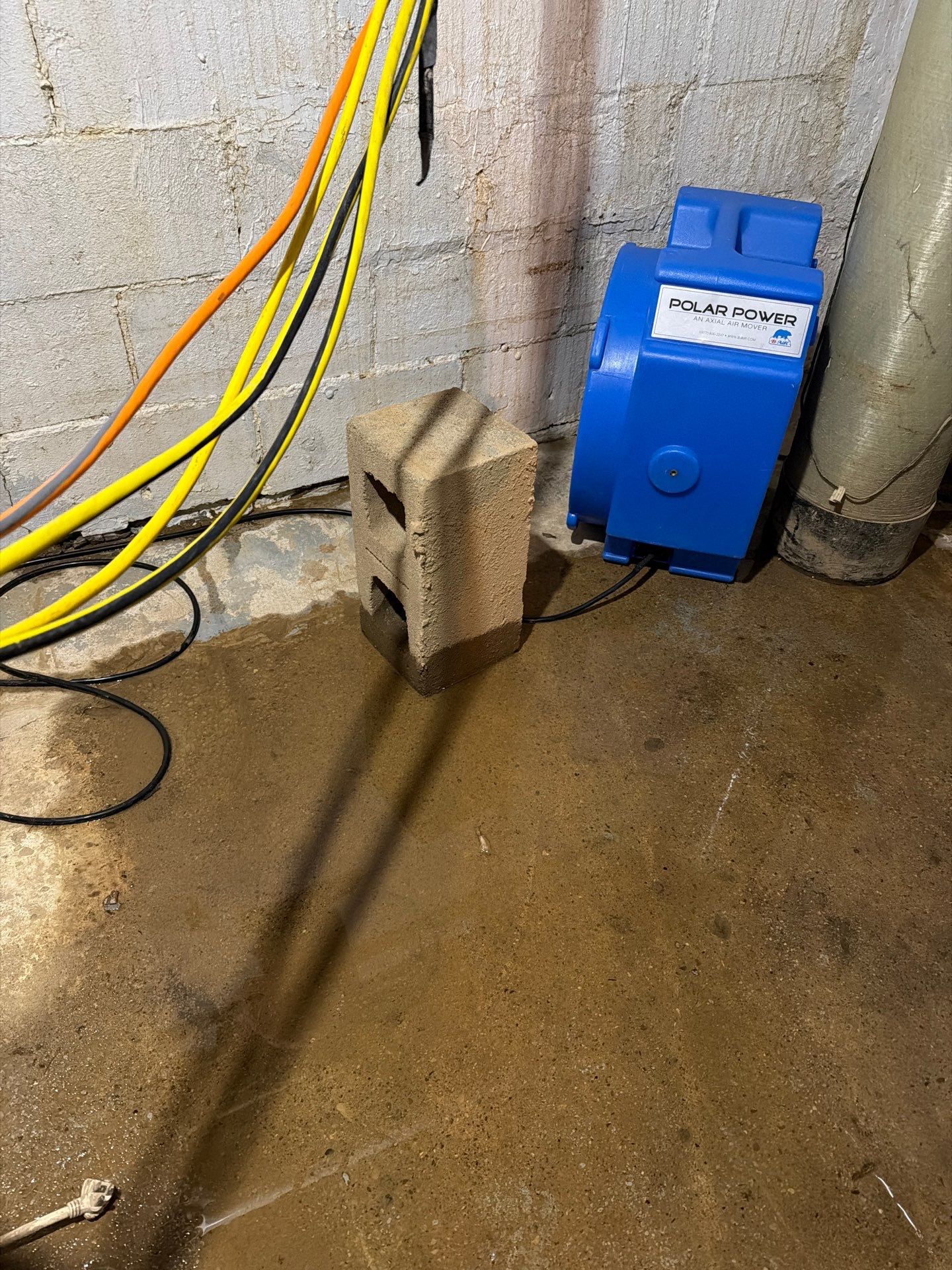
Step 1: Safety Triage (First 5 Minutes)
- Shut off electricity to affected zones at the breaker if water is near outlets or appliances.
- Locate and close the main water shutoff valve (typically near the front foundation wall or in the basement utility area in most Brownstown homes).
- Evacuate occupants from any space with sagging ceilings or visible structural bowing.
- Do not enter standing water deeper than 2 inches if electrical service is still active.
- If the source is sewage or toilet overflow downstream of the trap, treat it as Category 3 and stay out of the area.
- Move undamaged contents (electronics, documents, textiles) to a dry room at least 10 feet from the wet zone.
- Place aluminum foil squares or wood blocks under furniture legs sitting on wet carpet to prevent stain transfer.
Step 2: Source Identification and IICRC Categorization
- Identify the source: supply line, drain line, appliance, roof, foundation seepage, or sewer backup.
- Classify the water under IICRC S500 standards:
- Category 1: Clean water from a sanitary source (supply line, sink overflow).
- Category 2: Gray water with significant contamination (dishwasher, washing machine, aquarium).
- Category 3: Black water with grossly unsanitary content (sewage, flood water, standing water over 48 hours).
- Classify the loss Class 1 through 4 based on saturation area and material porosity.
- Document with photos and video before anything is moved. Insurance carriers in Brownstown require pre-mitigation evidence.
- Note that Category 1 water degrades to Category 2 within 24 to 48 hours, and to Category 3 after 72 hours, regardless of original source.
Step 5: Controlled Demolition
- Drywall is cut 12 to 24 inches above the visible waterline in clean horizontal flood cuts.
- Wet insulation (fiberglass or cellulose) is bagged and removed. It does not dry in place reliably.
- Baseboards are pulled and either salvaged or replaced based on material and contamination level.
- Subfloor sections that exceed 28 percent moisture content for more than 72 hours are flagged for replacement.
- Cabinet toe-kicks are removed to access trapped water under base cabinets.
- All demolition debris is bagged in 6-mil polyethylene and removed daily to prevent secondary contamination.
Step 3: Emergency Contact and Response Window
- Call Brownstown Water Restoration at the 24/7 emergency line. Average dispatch in Brownstown runs 45 to 90 minutes depending on time of day and weather.
- Have ready: address, water source if known, approximate square footage affected, and insurance carrier.
- Review our first steps after water damage checklist while you wait if it is safe to do so.
- Begin a written timeline. Note when you discovered the damage, when you called, and when help arrived. Adjusters use this.
- Contact your insurance carrier within the same business day. Most policies require notification within 24 to 72 hours of discovery.
- Do not authorize any non-emergency work until Brownstown Water Restoration arrives and provides a written scope.
Step 7: Structural Drying
- Air movers are placed at 12 to 16 foot intervals around the perimeter, angled at 15 to 45 degrees toward wet surfaces.
- Low-grain refrigerant (LGR) dehumidifiers are sized at one unit per 1,000 to 1,500 square feet of affected space.
- Target conditions: 30 to 50 percent relative humidity, 70 to 90 degrees Fahrenheit, grain depression of at least 30.
- Daily monitoring with moisture meters until materials return to dry standard (typically 12 to 16 percent for wood, 0.5 to 1.0 percent for drywall).
- Drying time runs 3 to 5 days for most residential losses in Brownstown. Hardwood floors can take 10 to 21 days.
- Specialty drying systems (Injectidry mats, wall cavity ventilation) are deployed when structural elements must be preserved.
Step 9: Reconstruction
- Drywall replacement, texture matching, primer, and paint.
- Flooring reinstallation: carpet, LVP, tile, or hardwood refinishing.
- Trim, baseboard, and cabinetry rebuild as needed.
- Final walkthrough with moisture readings documented in the closeout report.
Cost Ranges in Brownstown
- Minor Category 1 loss (one room, under 200 sq ft): $1,200 to $3,500.
- Moderate loss (multiple rooms, Category 1 or 2): $3,500 to $9,000.
- Major basement flood (Category 2, 800 to 1,500 sq ft): $8,000 to $18,000. See our basement flooding service page for scope details.
- Category 3 sewage loss: typically 1.5 to 2x equivalent Category 1 pricing due to PPE, containment, and disposal.
- Reconstruction adds 30 to 60 percent on top of mitigation depending on finishes.
- Equipment rental on extended drying jobs runs $75 to $150 per air mover per day and $150 to $250 per dehumidifier per day.
- Specialty hardwood drying systems add $1,500 to $4,000 to the mitigation total.
Step 6: Antimicrobial Treatment
- EPA-registered antimicrobial is applied to all affected substrates after extraction.
- Category 3 losses receive a two-stage application: cleaning agent first, then antimicrobial.
- HEPA air scrubbers (500 to 2000 CFM units) run continuously to capture airborne spores. Review the 24 to 48 hour mold window to understand why this stage is non-negotiable.
- Containment barriers of 6-mil poly are installed at room transitions when Category 2 or 3 work is active.
- Negative air pressure is established at 4 to 6 air changes per hour inside contained zones.
Step 4: Water Extraction (Hours 1 to 6)
- Truck-mounted or portable extractors pull standing water at 100 to 200 gallons per hour.
- Carpet is detached from tack strips so water beneath the padding can be removed.
- Padding is almost always discarded on Category 2 or 3 losses. Carpet may be salvageable on Category 1.
- Hardwood flooring is checked with a pin moisture meter. Readings above 16 percent require aggressive drying or controlled demolition.
- Cavity inspections behind baseboards and inside wall voids are completed with thermal imaging.
- Weighted extraction tools (rovers) are passed over carpet at a rate of 2 feet per second for full water removal.
- Ceiling cavities with active drips are vented with 2-inch weep holes drilled at low points to release trapped water.
Step 8: Post-Mitigation Verification
- Final moisture readings are taken at 10 to 15 points across the affected area and logged.
- Three consecutive readings at dry standard, taken 24 hours apart, confirm completion.
- Air quality sampling is recommended on Category 3 losses before reconstruction begins.
- A signed certificate of completion is issued to the homeowner and insurance carrier.
Insurance and Documentation
- Most homeowner policies in Brownstown cover sudden and accidental water damage. Gradual leaks and flood from rising surface water generally are not covered without a flood endorsement.
- Brownstown Water Restoration bills insurance directly on approved claims and provides line-item Xactimate estimates that adjusters recognize.
- Keep all receipts for hotel stays, meals, and replacement essentials if your home is uninhabitable. Loss-of-use coverage reimburses these.
- Request a copy of the adjuster's scope and compare line items against the Brownstown Water Restoration estimate before signing off.
- Depreciation is held back on the initial check and released after reconstruction is complete and invoiced.